
Home monitor · While you're out
Dog barking when you're out? How to hear it, and what each bark means
Most owners never hear the barking that happens after they leave. The neighbors do. Home monitor turns a spare iPhone or iPad into a barking monitor that doesn't just count barks: it tells you what kind each one was, so the pattern starts to mean something.
The short version
- It happens more than you think. In a study that filmed dogs with separation problems home alone, vocalizing was what they did most, and it usually started within minutes of the door closing.
- Hear it. A spare iPhone or iPad stays home and listens. Each barking episode reaches your phone with its time and length, and an alert if it goes on.
- Know what it was. Every episode is labeled Alarm, Attention, Food or Play, with how excited your dog sounded, so the postman and a dog who hates being left stop looking the same.
- Private. Audio only, no camera. Only moments with a dog are kept, in your own iCloud, for 7 days.
Why do dogs bark when you leave?
In the US, searches for “why do dogs bark when you leave” have roughly doubled over the past year. There isn't one answer, because a dog alone at home barks for the same reasons as a dog with company, plus one more:
- Something outside. A delivery, a knock, a dog walking past the window. These are alert barks, and with nobody home to settle them, they can run on.
- Wanting company back. Barks aimed at getting someone to come. They often come in bursts soon after you go.
- Boredom. A dog with nothing to do for hours finds something to do, and barking is free.
- Separation distress. Some dogs panic when they're left. Barking, howling and whining are the signs you're most likely to hear, often with pacing, panting, drooling or scratching at the door.
The last one matters most, and it's the hardest to spot. In one study, researchers filmed 23 dogs with separation-related problems after their owners left. Vocalizing took up more of the dogs' time than anything else, about 23%, and on average it started just over three minutes after the owner walked out. The authors note that owners' own reports can underestimate these problems. It makes sense: if you only ever see your dog when you're home, you only ever see a dog who isn't alone.
You can't fix barking you never hear
Many owners find out from a neighbor, a note on the door or a landlord; in the UK, “neighbours dog barking all day” is a common search. Before you change anything, it helps to know three things: when the barking happens, how long it lasts and what kind of barking it is.
The usual options each answer part of that. A neighbor can tell you it happens, but rarely when. A pet camera shows you a moment, if you happen to be watching. A recording of the whole day is honest, but nobody wants to listen to eight hours of an empty room.
Hear home while you're out
Home monitor (Premium) turns a spare iPhone or iPad into a dog barking monitor. Leave it where your dog spends the day, open Home monitor, choose Use this iPhone as the monitor and tap Start listening. It keeps listening with the screen locked. Sounds are checked on the device, speech and TV chatter are dropped, and only the moments where a dog is heard are kept.
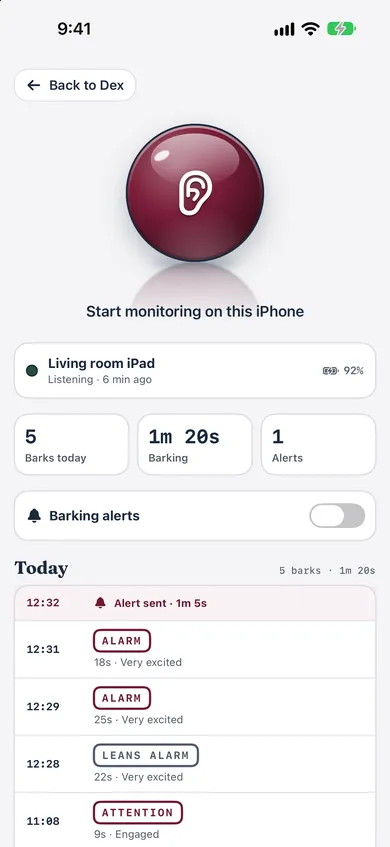
On your own iPhone, signed in to the same Apple Account, choose This is my iPhone: get barking alerts. That's the whole setup. You'll see a timeline of every barking episode, the totals for the day, the monitor's battery, and an alert if the barking goes on.
What is your dog saying while you're out?
A monitor that only says “barking detected” leaves you guessing. Was that the postman, or panic? So Bokedex reads every episode on the device, with the same bark model as the Bark screen, and gives it a label:
- Alarm. An alert bark: something caught your dog's attention, like a knock, a delivery or a dog outside.
- Attention. Asking for contact: for someone to come, play or open the door.
- Food. Sounds like asking for food or a treat.
- Play. Upbeat and social. Rare in a dog who's alone, so worth a look if another pet is home.
- Leans alarm, leans attention… A bark that sits between two kinds shows the one it's closest to, in grey.
Next to each label is how long the episode lasted and how excited your dog sounded: calm, engaged or very excited. Turn on clips and each episode keeps its first 6 seconds, so you can press play and hear it yourself.
Barks carry information about the situation. When researchers analyzed 4,672 barks from 10 dogs, the barks given when a stranger rang the doorbell were harsher, lower and longer, repeated faster, than the barks given when a dog was shut away from its owner or playing. People can sort recorded barks by situation well above chance, and so can a machine learning model trained on barks from six situations. Bokedex is built on that signal: the kind of bark, and how excited your dog sounds. More on how bark reads work.
Reading a week of barking
One bark tells you little. A week of timelines tells you a lot. Patterns worth looking for:
- Alarm barks at the same times every day. Usually something outside: the mail, the school run, a neighbor's dog. Block the view of the street, and practise calm around the doorbell and knocking with Calm to sounds.
- Barking soon after you leave, again and again. Especially when it's very excited and keeps coming back. That's the pattern the filming studies describe, and it's worth a talk with your vet.
- Long stretches in the afternoon. Often boredom, or a dog who's been alone too long. A sniffy walk before you go, a food puzzle and a midday visit help more than any correction.
- A few short, calm barks a day. That's a dog being a dog. If a neighbor says your dog barks all day, the timeline is your answer.
Each episode gives you the when, the how long and the kind of bark, and a week of them shows you the pattern. It's exactly what a trainer or vet will ask about, so jot down when you left and when you came back too.
What to do with what you find
Once you know what kind of barking it is, Train has a plan for it. These are Premium routines:
- Quiet at home, for barking at sounds and the window: block the view, pair trigger sounds with treats, then build up to a calm look at you after a knock or the doorbell.
- Separation distress, for barking that happens mostly when your dog is alone: company first, so they're never left past their limit, then absences of seconds that grow only while your dog stays relaxed. The plan asks you to film those short practice absences; Home monitor tells you what happens during the long ones. Separation distress is panic, not bad behavior, so talk to your vet before you start. Many dogs need medicine as well as training.
- Quiet minute, for barking while you're home: the phone listens and buzzes “Treat now” after a quiet stretch, so quiet is what pays.
Whatever the cause, skip bark collars and punishment. They can stop the noise for a while without changing why your dog barks, and punishing a frightened dog can make the fear worse. If barking comes with destruction, accidents in the house, trembling or hiding, our guide on when to get professional help covers the next step. All training in Bokedex is reward-based.
Private by design: no camera, no server
Home monitor is audio only. There's no camera, and nothing is kept unless a dog is heard. Barks sync through your own private iCloud, not a Bokedex server, so we can't see or hear anything. Clips are optional, last 6 seconds and, like the timeline, are deleted after 7 days. If other people live with you, tell them it's listening; the monitor's setup screen reminds you to.
Tips for the spare phone
- Put it in the room where your dog spends the day, not by the front door where every passer-by sounds loud.
- Plug it in. It checks in every 15 minutes with its battery level, and if it goes quiet for about 40 minutes, your phone shows that it may have stopped.
- Lock the screen and leave Bokedex open on the monitor. It keeps listening until you tap Stop.
- Pick your alert: after 30 seconds, 1 minute or 2 minutes of barking within five minutes, or off. You'll get at most one alert every 15 minutes.
- Turn the TV off before you go, so every bark on the timeline is your dog's.
Try Home monitor
Home monitor is part of Bokedex Premium ($9.99 a year in the US), along with unlimited reads, every training routine and the camera coach. You need two devices on the same Apple Account: a spare iPhone or iPad with iOS 17 or later that stays home, and your own iPhone. See how the barking monitor works, then try it the next time you head out. If the timeline surprises you, I'd like to hear about it: get in touch.
Sources
- Palestrini C, Minero M, Cannas S, Rossi E, Frank D. Video analysis of dogs with separation-related behaviors. Applied Animal Behaviour Science. 2010;124(1-2):61-67.
- Yin S, McCowan B. Barking in domestic dogs: context specificity and individual identification. Animal Behaviour. 2004;68(2):343-355.
- Pongrácz P, Molnár C, Miklósi Á, Csányi V. Human listeners are able to classify dog (Canis familiaris) barks recorded in different situations. Journal of Comparative Psychology. 2005;119(2):136-144.
- Molnár C, Kaplan F, Roy P, Pachet F, Pongrácz P, Dóka A, Miklósi Á. Classification of dog barks: a machine learning approach. Animal Cognition. 2008;11(3):389-400.