
- Bokedex
- Calm to sounds
No. 006 · Calm to sounds
Help your dog stay calm with fireworks, thunder and the doorbell
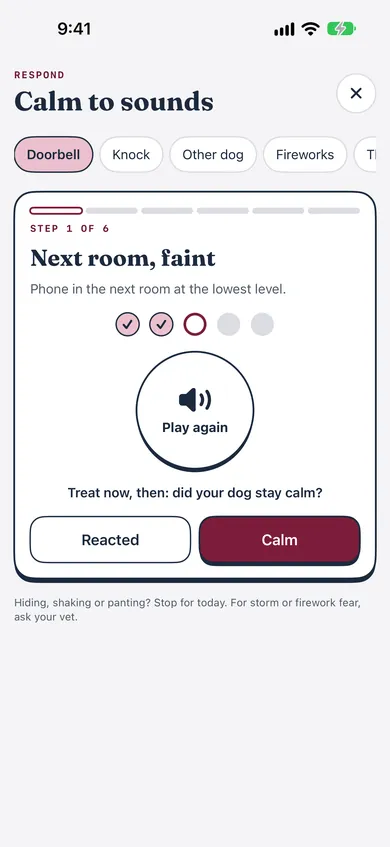
Calm to sounds plays the noises your dog reacts to, starting almost too quiet to notice, and pairs each one with a treat. Six steps take the sound from the next room to real-life level, only as fast as your dog stays relaxed.

How it works
Three steps.
-
Pick the sound
Doorbell, knock, another dog, fireworks, thunder, the vacuum or a siren.
-
Play, then treat
Bokedex plays the sound at the step's level. Treat right after, every time, calm or not.
-
Tell it how it went
Tap Calm or Reacted. Calm sets move you on; reactions keep the drill where it is or step it back.
The six steps
- 1. Next room, faint
-
Phone in the next room at the lowest level.
- 2. Same room, faint
-
Phone across the room, still very quiet.
- 3. Soft, while resting
-
A little louder while your dog lies down.
- 4. Medium, phone closer
-
Medium level, phone a few steps away.
- 5. Twice in a row
-
Two sounds back to back, then treat.
- 6. Real life
-
Near real level while you move around.
Why it starts so quiet
The drill uses desensitization and counter-conditioning: the sound stays below the level that worries your dog, and it always predicts something good. Over many short sets, the sound starts to mean “treat is coming” instead of “danger”. Going louder too soon undoes the work, which is why each step waits for calm sets before moving on.
Signs to stop for today
Stop, let your dog settle, and start the next session a step lower.
- Hiding, shaking, panting or pacing.
- Refusing treats they usually love.
- Staring at the phone or the door and not settling.
- Barking or startling more with each play.
Before fireworks night or storm season
- Start weeks ahead. A few short sessions a day add up.
- Set up a quiet den: a covered crate or a corner with their bed, away from windows.
- Close curtains and play steady background noise on the night.
- For strong fear, ask your vet early. Some dogs need medication to cope, and that's fine.
What it can't do. Calm to sounds is for mild to moderate noise sensitivity. A dog who panics, hurts themselves or can't be calmed needs a vet or a veterinary behaviorist first.
Questions
Calm to sounds: common questions
How long does it take?
It depends on the dog and the sound. Expect weeks of short daily sessions rather than days, and go slower with sounds your dog finds hardest.
Which sounds are included?
Doorbell, knock, another dog barking, fireworks, thunder, the vacuum and a siren.
Should I treat even if my dog reacted?
Yes. The sound should always predict a treat. Mark the rep as Reacted so the drill knows to go easier.
What if my dog is terrified of fireworks?
Talk to your vet before the season starts. Severe noise fear often needs medication alongside training, and a veterinary behaviorist can build a plan.
Guides
Read next
Also in Bokedex
The rest of the dex
 No. 002
 Bark
Record a few seconds and find out what the bark is about, and how worked up your dog is.
Alert · Attention · Food · Play No. 003
 Breed
One photo gives the closest breeds, mixes included, with a profile for each breed.
120 breeds No. 004
 Mood
A quick read of your dog's face from one photo, with what it usually means and one thing to do.
Happy · Relaxed · Tense · Low No. 005
 Train
Step-by-step plans for 18 skills, in sets of a few minutes. A camera coach times sits and stays.
18 skills · 4 stages No. 007
 Home monitor
Leave a spare iPhone at home. See when your dog barked and for how long, and get an alert if it goes on.
Premium · Your iCloudTry Calm to sounds on your dog.
Bokedex is free to download for iPhone and iPad. No account needed.